
Sustainability
Business Ethics, Values & Governance
Ethical integrity is fundamental to OMH’s organisational culture. We expect our employees and business partners to uphold the highest standards of legal, ethical, and policy compliance in all business activities. The Group’s Code of Conduct establishes the behaviour expected of our employees and representatives. It provides guidance on key areas including business ethics, conflict resolution, fair competition, sustainability, human rights, and community relations. Employees and stakeholders are encouraged to report any suspected breaches of the law or the Code of Conduct. OMH also encourages its business partners to acknowledge and commit to the principles of the Code of Conduct prior to entering into formal agreements with the Group.
Anti-Bribery & Corruption
OMH maintains a Group-wide Anti-Bribery and Corruption Standard that outlines the conduct expected of all directors, employees, and third parties, including agents and contractors. The Standard supports compliance with all anti-corruption laws and defines the responsibilities of those representing the Group in commercial dealings. Operations at OM Sarawak are governed by a dedicated Anti-Bribery and Anti-Corruption Policy aligned with the Malaysian Anti-Corruption Commission Act 2009, the Companies Act 2006, and the Penal Code. Regular training is conducted to ensure that employees are well-equipped with the knowledge to effectively navigate and mitigate risks associated with bribery and corruption within their respective domains.
Grievance Mechanisms & Whistleblowing
All operations maintain accessible and transparent grievance mechanisms for employees and stakeholders. These mechanisms are designed in accordance with the effectiveness criteria outlined in the United Nations Guiding Principles on Business and Human Rights. Employees are briefed on grievance procedures as part of the onboarding process. We are committed to investigating all reported matters in a fair and timely manner.
OMH encourages employees, officers, and contractors to report unlawful, improper, or unethical conduct. The Group’s Whistleblower Protection Standard provides a secure and confidential channel through which concerns may be raised anonymously without fear of reprisal. The Standard outlines the types of matters eligible for disclosure, reporting procedures, and the protections available for whistleblowers. It also ensures that individuals who raise concerns are protected from victimisation and supported throughout the reporting process.
Product Quality & Safety
Quality and safety are foundational tenets of our operational excellence. By consistently upholding these standards, we reinforce the trust and confidence that our customers and business partners place in us. We view product quality not only as a commercial requirement, but as a reflection of our technical discipline and process efficiency.
At OM Sarawak, the Quality Inspection Centre (QIC) serves as the custodian of our product quality management within our smelting plant. This dedicated unit is responsible for establishing and maintaining the quality control management system. Its responsibilities encompass vigilant oversight of weighing and sampling, as well as the issuance of detailed analysis reports for both incoming feedstock and finished products.
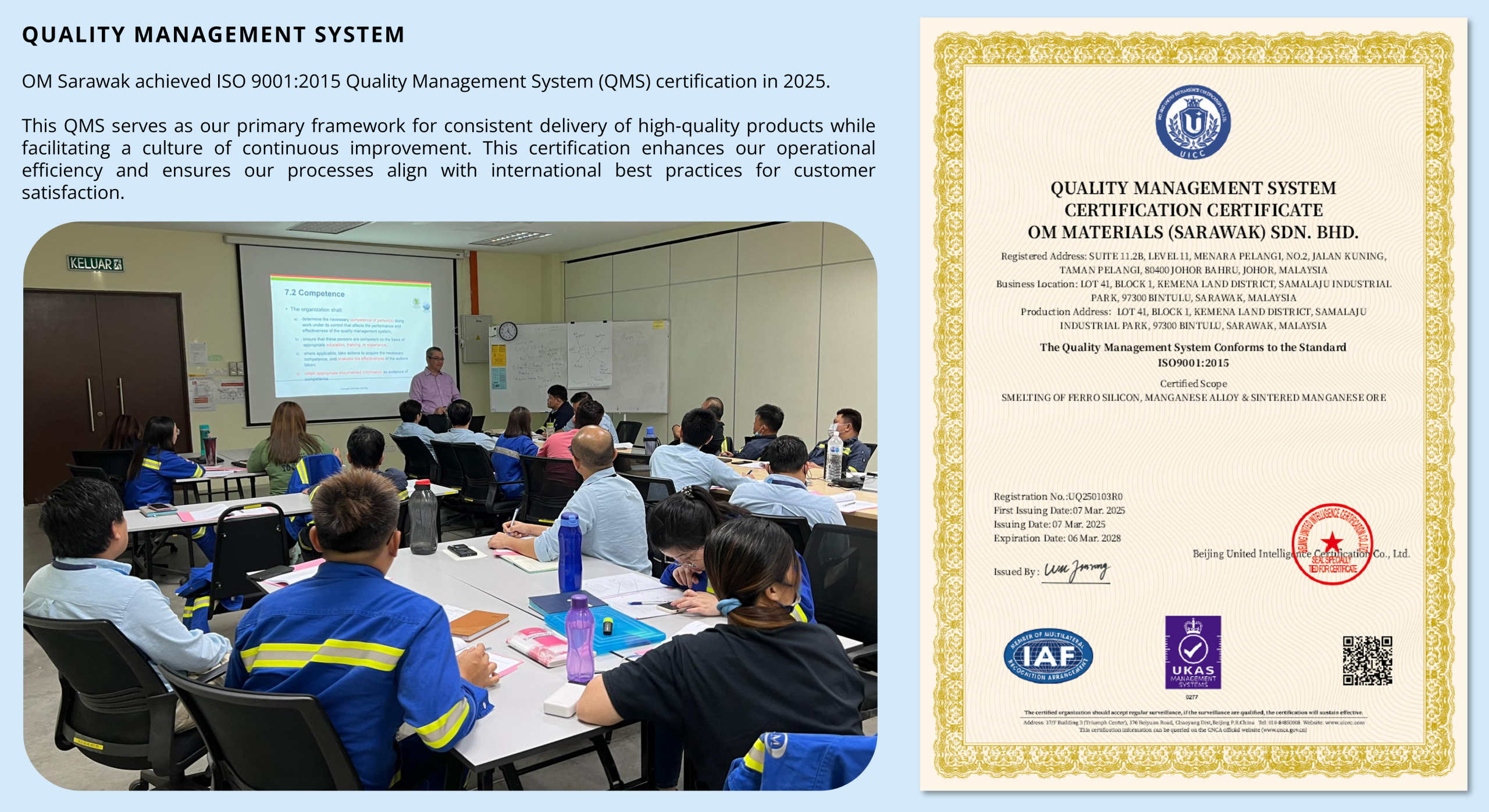
Ensuring the safety of our product range is of paramount importance. To adhere to stringent international standards, we subject our products to rigorous testing in accordance with the United Nations Recommendations on the Transport of Dangerous Goods, Manual of Tests and Criteria (Part III – 33.4.1.4). While our ferrosilicon and manganese alloy products are not classified as Class 4.3 Dangerous Goods, we remain committed to comprehensive safety measures. Even though our products are categorised as non-hazardous, we regularly provide customers with updated product safety information sheets. These documents offer precise instructions for safe handling, storage, and emergency response, covering critical areas such as product composition and classification, firefighting and accidental release protocols, exposure controls and personal protection, and stability, reactivity, and disposal recommendations. By providing this level of detail, we ensure that all stakeholders in our value chain are equipped to manage our products safely and responsibly across all stages of usage.
Supply Chain Management
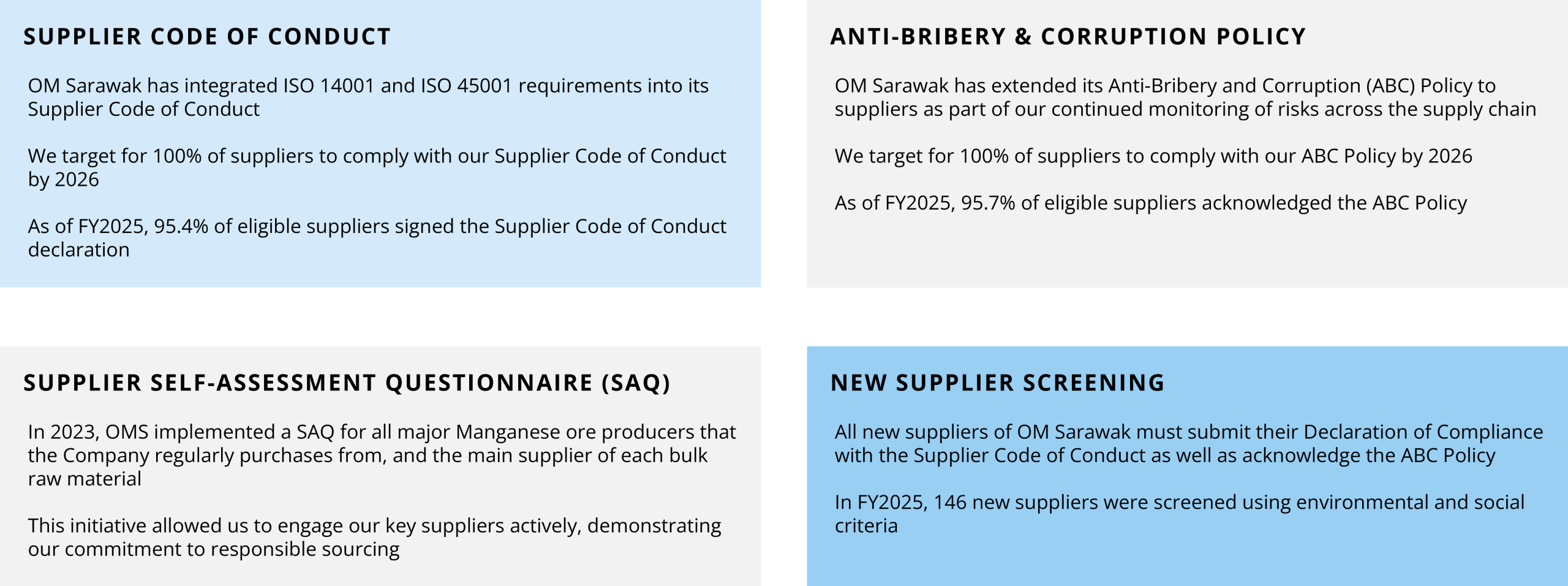
Our supply chain strategy is firmly anchored in a commitment to ethical, social, and environmental principles. By integrating these values into our engagements with suppliers, we ensure our business practices remain closely aligned with our long-term sustainability objectives.
Data Privacy & Cybersecurity
OMH maintains a robust framework for data protection and privacy, viewing the security of information assets as a critical component of overall operational resilience. In a commoditised and increasingly digitised industrial sector, the integrity of operational and financial data is paramount to mitigating systemic risk. OMH continuously evaluates its security posture to defend against evolving cyber threats that could lead to operational paralysis or the compromise of proprietary commercial information. A primary focus of the Group’s defensive strategy is the enhancement of disaster recovery capabilities to ensure business continuity. Infrastructure investments made are designed to minimise the duration of any potential disruption, thereby protecting the Group’s value chain from digital volatility. Technical controls are augmented by a focus on human capital risk management. OMH provides regular training and communication updates to ensure our employees can identify and neutralise emerging threats, such as phishing and social engineering. This proactive approach ensures that our staff are equipped to uphold our data security and privacy standards, maintaining a culture of vigilance across the organisation.